How Nonprofits Are Turning Toward Hope
By Lindsay Way
10-minute read
At Securing The Future, Perspective Guides facilitated a session about the interplay between grief and hope. We recognize that nonprofits leaders often carry enormous grief: for the communities they serve, the problems that persist, and the gap between vision and reality. What we don’t always talk about is what to do with that grief.
The Room Before it Came Alive
This message must have resonated, because we led the workshop in a conference room that was packed with Cincinnati-area nonprofit leaders, but oddly quiet in anticipation of our time together. That silence had weight to it. These were people who carry a lot, and it was palpable in the room.
We passed out colorful markers and sticky notes, encouraged chair shuffling from the formal conference room grid into conversation zones, and watched the room come alive with our opening question: what brought you to nonprofit work?
People lit up as they talked about their background, life experiences, and passion for their work. We heard stories about moments that marked the people in the room and set them on the path toward nonprofit service. The energy was immediate and genuine, the kind that appears when people are invited to share their stories.
Naming What’s Heavy
Next, we asked what concerns people had for their work – both organizational and systemic. The list of concerns was, perhaps unsurprisingly, long.
Systemic issues like funding and the political and economic climate are the air that nonprofit professionals breathe: these forces are all-consuming in their largeness, impact every part of the work, and exist beyond any one person’s control. Also weighing heavy: the material realities of the communities served. The leaders in the room noted people’s material needs are increasingly going unmet; the volume of people requiring support is increasing; and demographic inequalities impact access to needed services.
Industry trends added more to the pile: resource competition, leadership retention, and organizations’ capacity strained to the limits.
Lastly, there were deeply human concerns: can nonprofit leaders share power and collaborate effectively? Can they manage conflict? Can they care for themselves and each other as they do deep, difficult work? Can they balance accountability with individual care and concern for colleagues? And can they sustain meaningful lives while doing meaningful work?
All the worries landed on vibrant sticky notes, handwritten with care, and stuck to the wall, sprawling across the conference room. I dubbed it the worry wall. It was overwhelming.
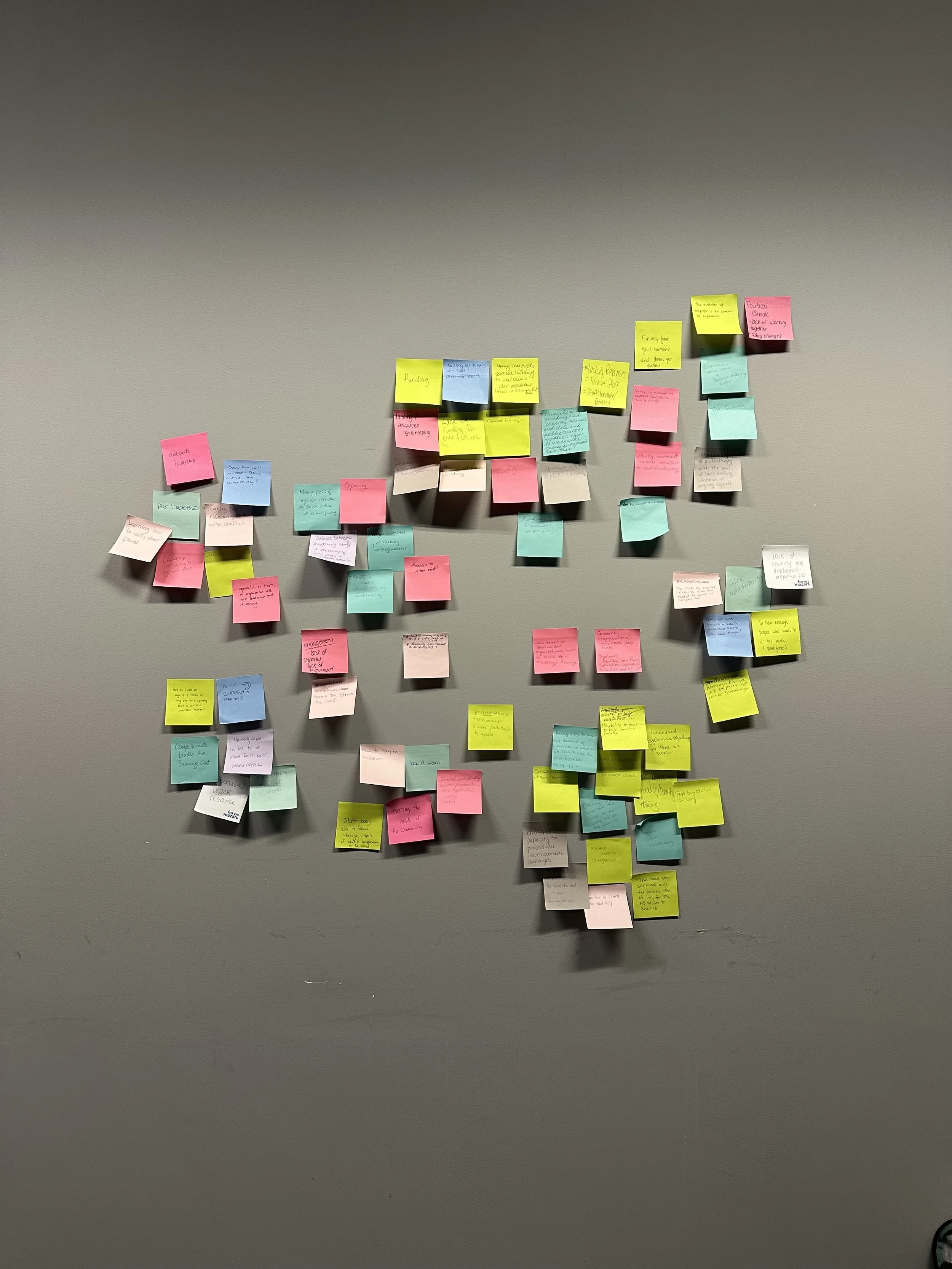
The “Worry Wall”
Overwhelming? Yes.
Revealing of our love for the work? Also yes.
What the Worry Tells Us
We asked people to reflect on what surprised them most about their feelings as they watched the worry wall fill with sticky notes. And look, we get it: sharing deep feelings in a professional setting is uncomfortable and maybe a bit unconventional, especially at a conference where we show up to put our best networking faces forward. But these folks responded so beautifully. I’m surprised I felt so strongly about this. It felt good just to get that off my chest.
At Perspective Guides, we hold two truth close (both drawn from The Work That Reconnects).
First: grief is proportional to love. If the worries are huge, so is the love underneath them. Our worry is a signal that our capacity to love is still online, still showing us the way, if we let it.
Second, what we do with that signal matters. Grief left untended can become toxic. It can weigh us down, stop us in our tracks, make the world feel impossible. But if that grief is held, witnessed, and moved through, it becomes something else entirely. It becomes fuel that sustains our work.
The message grief carries is clear: we are human, we are connected to our work and to each other, and we have capacity to keep going.
Turning Toward Hope
So, we asked people to think toward the future and name what they deeply hope for. Because we can only work toward a future we envision. The room came alive again, but differently this time. People shared visions of abundance; their communities having all they needed; dreams of collaboration; pride in their work.
As laughter and voices filled the room, the “worry wall” almost receded in size. It didn’t disappear: the worries are still real, and pretending otherwise would be its own kind of harm. But it seemed to shrink relative to the heart and love in the room.
A group came together and listened to each other’s dreams, despite the worries in the world. Joanna Macy put it this way: “the biggest gift you can give is to be absolutely present…the main thing is that you’re showing up, that you’re here and that you’re finding ever more capacity to love this world because it will not be healed without that."
These leaders were present to each other. And that willingness to sit with the full weight of nonprofit work and still lean toward hope is exactly what it looks like to use grief as fuel.
What We Carry With Us
The magical hour of sharing was nearly over. We asked people to write to a final prompt: a small step I can take this week towards that hope is…

The “Hope Wall”
A visual representation of dreams and commitments.
Their responses showed a personal commitments: to start the day with gratitude. To continue building community. They revealed professional commitments too: I can reaffirm my leadership team. I can collaborate with at least one person from this workshop. Their responses were real and revealed commitments to sustained efforts over time.
Group members left their sticky notes on the wall opposite the worry wall, in a trail of small commitments leading toward the door. It was a visual reminder that the grief, love, and hope didn’t stay in the room with us. They filtered back into the Cincinnati-area nonprofit world, transformed into action.
If these leaders’ presence with each other is any indication, the nonprofit sector here in Cincinnati is well-resourced for the road ahead, not because the problems are smaller, but because the people carrying them know how to work with both grief and hope.
Perspective Guides supports nonprofit leaders navigating change: the emotional, relational, and operational dimensions of the work. learn more about our facilitation, strategic, and interim leadership services here.