Why Smart Groups Make Bad Decisions (And How to Fix It)
By Rosie Santos
12-minute read
You've assembled a dedicated team. Everyone cares deeply about the mission. They work harder than anyone expects. They make thoughtful decisions based on the best information available.
And yet—relationships with other stakeholders are fraying. Collaboration feels harder, not easier. Well-intentioned input feels like criticism. The very commitment that makes your group effective is somehow creating barriers with the people you need most.
If this sounds familiar, you're not experiencing a failure of character or judgment. You're experiencing something much more fundamental: the invisible force of group identity.
The Problem Nobody Sees Coming
Here's what makes organizational decision-making so difficult: we're not just dealing with incomplete information or time pressure (though those are real). We're dealing with two powerful forces that most of us don't even realize are shaping our choices:
Bounded rationality: We make decisions with limited information, constrained time, and imperfect analytical abilities—especially under stress.
Group identity effects: Once we identify as part of a group, our perception of reality itself shifts—often without any awareness that it's happening.
Together, these forces explain why smart, dedicated people can make decisions that damage the very relationships they need to succeed.
When "Straightforward" Decisions Aren't
Let’s explore an example that might be all too familiar for mission-based organizations. A committed board is facing what looks like a straightforward financial decision: whether to implement layoffs during a challenging season.
But straightforward decisions have clear alternatives with known parameters. In this example, the parameters aren’t at all. It’s what decision researchers call "poorly defined"—where you first must clarify what you're deciding and what trade-offs matter.
The board is trying to reconcile competing commitments:
Supporting staff who'd dedicated themselves to the mission
Ensuring organizational survival
Creating space for strategic planning
Managing uncertainty about which organizational model would work
Add emotional factors—board members' own exhaustion, anxiety about the future, pain at having to make cuts—and bounded rationality kicked in hard. They were making consequential decisions while:
Operating with incomplete information about future funding
Facing severe time pressure
Managing cognitive load from their own stress and burnout
Trying to maintain strategic thinking while emotionally depleted
The board decides to move forward with layoffs, and it might be the right one. Group identity shapes what happens after the decision is made.
The Invisible Force of "Us" and "Them"
Here's what research shows: even arbitrary group assignments—being told you're on the "blue team" versus the "red team"—immediately create bias. We favor our group members. We're suspicious of outsiders. We interpret the same information differently depending on which group it comes from.
Now add real stakes, shared history, and emotional stress.
Our example board had a strong shared identity built around its organizational commitment and willingness to work harder than typical governance groups. That identity was genuinely positive—it's why they could make difficult decisions at all.
But that same identity, under stress, created an unintended dynamic with other stakeholder groups.
A dedicated group of supporters—people who've been fundraising and advocating for the organization—want to provide input and collaborate on the path forward. Objectively, their perspectives could be valuable.
But through the lens of an exhausted board that had just made painful layoff decisions? Stakeholder input starts feeling like criticism. Questions feel like challenges. Offers to help feel like intrusions.
The research shows this isn't about bad attitudes—it's about how group identity literally shapes perception. In one study, people smelled the same t-shirt differently depending on whether they were told it belonged to their group or another group. Same shirt, different perceptions, based solely on group identity.
When you're operating under stress with limited emotional reserves, and you've just made agonizing decisions you believe demonstrate your commitment to the mission, it's almost impossible not to perceive outsider input through a defensive lens.
The "Outgroup Hate" Trap
Here's where it gets more concerning. Recent research on polarization shows that group dynamics are increasingly driven not by love for your own group, but by negative feelings toward other groups—"outgroup hate" rather than "ingroup love."
You don't have to dislike the other stakeholders as people. But when you're exhausted and stressed, and they're questioning decisions you agonized over, your brain doesn't process "they care about the same mission we do." It processes "they don't understand what we're dealing with."
Each group develops its own narrative:
"We're the ones making hard choices while they criticize from the sidelines."
"We're trying to help, but they won't listen to anyone outside their circle. It’s their fault we’re in this situation to begin with."
Both groups believe they're acting from mission commitment. Both are probably right about their own motivations. But group identity dynamics and cognitive limitations under stress create perceptual rifts that undermine the collaboration everyone wants.
The Path Forward: Superordinate Identity
The most hopeful insight from research: you can overcome these dynamics by creating what's called a "superordinate identity"—a shared identity that transcends subgroup boundaries.
The example that proves this works: When Mohamed Salah, a Muslim soccer star, joined Liverpool, something remarkable happened. In a region with documented tensions around immigration and religious differences, hate crimes dropped 16% after he joined. Why? Because he became part of "us"—a Liverpool player—which created a stronger identity than the religious and ethnic categories that had previously divided people.
For organizations, this means reframing relationships around superordinate goals that everyone genuinely shares:
Organizational sustainability: Everyone wants the organization to survive and thrive—the board, staff, donors, volunteers, and all other stakeholders.
Mission effectiveness: Everyone cares about impact and doing the work well.
Community benefit: Everyone is ultimately here because they care about the people or cause being served.
Practical Strategies for Building Superordinate Identity
Acknowledge exhaustion and stress openly. "We're all operating under significant pressure right now" isn't an excuse—it's creating shared context that helps people recognize when bounded rationality and emotional depletion are affecting perception.
Name the shared stakes explicitly. "We all want this organization to succeed. We might have different ideas about how, but we share that fundamental goal."
Create structures that emphasize shared identity over subgroup boundaries. Instead of "board meetings" and "stakeholder input sessions," try "strategic planning sessions with board and key stakeholders," where everyone is explicitly positioned as part of the same problem-solving team.
Watch for "us versus them" language and reframe it. When you catch yourself or others saying, "they don't understand" or "they're not being realistic," pause and ask: "What would help us understand each other's constraints better?"
Build in reflection time. When making emotionally charged decisions under stress, explicitly acknowledge: "We're making this choice with limited information, under time pressure, while exhausted. What are we potentially missing because of those limitations?"
Seek outside perspectives before finalizing difficult decisions. Not to override your judgment, but to catch blind spots created by group identity and bounded rationality. An outside facilitator or advisor who isn't enmeshed in the group dynamics can see things you literally cannot see from inside.
The Hard Truth
You can be deeply committed, work incredibly hard, and make thoughtful decisions—and still damage critical relationships because of forces you didn't know were operating.
The board in this example believed their difficult decisions demonstrated mission dedication. They were right. But the outcome—strained stakeholder relationships—showed that group identity dynamics and cognitive limitations under stress were undermining the very collaboration they needed.
This isn't about fault. It's about awareness.
The next time you're facing difficult decisions as part of a committed group, ask yourself:
Are we operating under conditions (stress, time pressure, incomplete information) that limit our decision-making capacity?
Is our shared group identity—even though it's positive—potentially shaping how we perceive input from others?
Are we interpreting stakeholder perspectives through a defensive lens we don't realize we're using?
What superordinate identity could we emphasize that would make collaboration feel natural rather than threatening?
What would an outsider see that we're missing because we're inside the group dynamics?
The goal isn't to eliminate group identity—strong teams need shared identity to function. The goal is to recognize when that identity starts creating "us versus them" dynamics that undermine your actual objectives.
Because sometimes the people who feel like critics are potential collaborators. And sometimes the very commitment that makes you effective is the same force that's isolating you from the people you need most.
That's when superordinate identity becomes not just helpful, but essential.
Perspective Guides accompanies individuals and organizations through profound moments of change. Our work is grounded in rest, connection, and the belief that transformation is a collective endeavor. Learn more about our strategic services and coaching offerings.
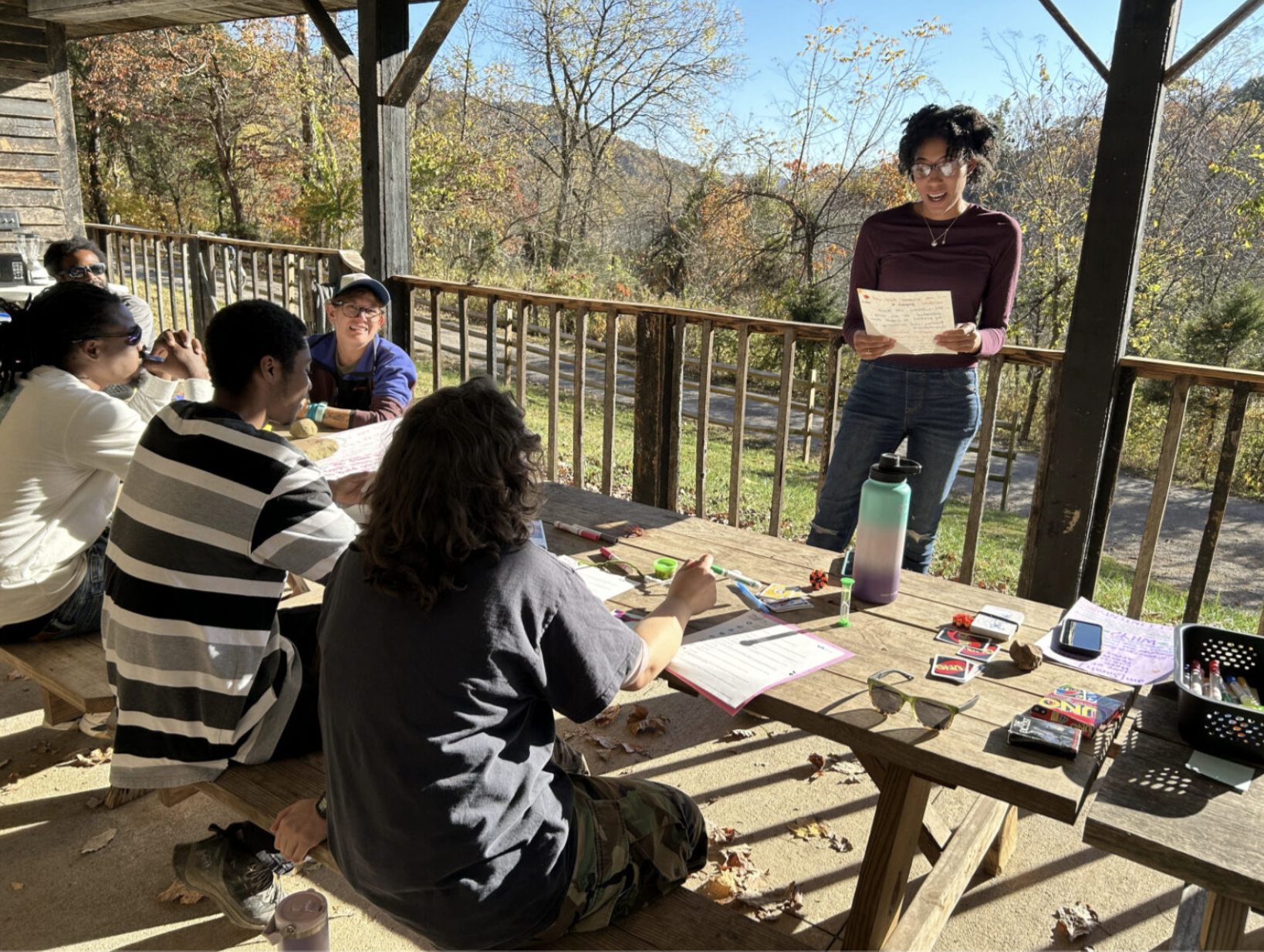
Client strategic retreat.